Tic-tac-toe
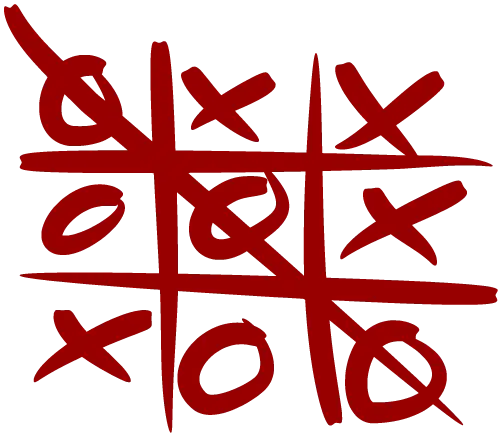 The game of tic-tac-toe — known by various names depending on the region: *tic-tac-toe* in the US, *gomoku* in Asia, *piškvorky* in Czech republic — is not just a classic pastime, but a true cultural relic whose roots date back to ancient times. The first traces of its prototypes were found on clay tablets in Mesopotamia and on the walls of Egyptian temples, where children and adults drew simple grids on sand or stones. In ancient Rome, a version similar to our "three in a row" was played, and in China it evolved into *wuziqi* (five in a row), which is now known as *gomoku*. This fascinating evolution shows how universal the human need is: to compete, but in an honest, simple, and respectful way. The basic rules have remained unchanged for centuries: two players take turns placing their symbols — a circle or a cross — on the board, and the winner is the first to line up a certain number of symbols in a continuous row: horizontal, vertical, or diagonal.
In our version of this cult game, we decided to return to its original spirit – not as a technological race, but as a quiet dialogue between players... or between a player and a machine that does not pretend to be a world champion, but a friendly companion in the game. Everything here can be customized to your own preferences: from a small, intimate 3x3 playing field (ideal for beginners) to larger versions – 5x5, 10x10, and even 15x15 – where the win is not just three, but four, five, or six symbols in a row. The absence of complex artificial intelligence is a deliberate choice: instead of an "unbeatable opponent," the computer plays like a real human being – sometimes making mistakes, "wasting" opportunities to win, reacting with a slight delay, or deliberately choosing a suboptimal move to leave room for success.
Everyone can set up the game according to their own preferences, but we have a few suggestions.
- On small boards, i.e. up to 6x6, it is worth leaving the winning number of symbols at 3 in a row. The game is then very enjoyable and quite fast.
- On boards from 7x7 to 11x11, it is worth setting the winning number to 4 in a line. For one simple reason: the number of lines consisting of three symbols on such a board is very large. Points come one after another, making it difficult to see who currently has the advantage. Increasing the winning number makes the game more strategic and calmer.
- On boards from 12x12 fields, it is best to set 5 symbols in a line. This gives us a classic Gomoku game. It requires a little more patience, logical thinking and foresight, but the satisfaction from each point scored is enormous.
- Six symbols in a line is a very, very difficult version. Just right for very experienced players.
These are, of course, only our recommendations, but they are based on dozens of trial games. Everyone can set up the game any way they want, because in the end it's supposed to be fun, not rigid adherence to rules. It is not a game of dominance, but one of enjoyment, relaxation, and small daily victories—great fun for children, teenagers, adults, and even seniors who are looking for a gentle, engaging form of mental activity.
 However, it should be emphasized that this seemingly simple game has enormous educational and therapeutic potential — especially when working with children and people with various forms of disabilities (e.g., Asperger's syndrome, ADHD, dyslexia, cerebral palsy, or cognitive difficulties). The game exercises many basic but key executive functions: logical thinking ("if I place a cross here, what will my opponent do?"), strategic planning (anticipating several moves ahead), impulse control (learning to wait for your turn), and cognitive flexibility—the ability to quickly switch between options and adjust plans "on the fly." For children in early school age, it is a great introduction to the world of social rules: waiting in line, fair play in tournaments, coping with defeat, and the joy of one's own success. For people with concentration problems, the friendly, visually clear format helps them maintain their attention longer than typical school assignments. And for people with limitations (e.g., problems with precise grasping), our digital version eliminates the physical barrier— all it takes is a single click or touch of the screen.
In addition, the game can be a great tool in occupational therapy or speech therapy: it supports the development of working memory ("where were my symbols already?"), strengthens visual-motor coordination, and develops spatial perception. Psychologists and therapists often use it as a "gentle start" when working with children who are unwilling to cooperate—its simplicity does not cause fear of failure, and successes come quickly, which builds a sense of effectiveness and motivation for further action. For parents, it is also a great opportunity for shared, screen-based—but real—interaction with their child: no pressure, no judgment, just the joy of thinking together and laughing at the computer "taking over" the playing field, which... forgot to block the win.
It's not just a game. It's a small laboratory of life skills — wrapped up in a few squares and two simple symbols. We invite you to discover, make mistakes, win... and quietly enjoy the fact that something so ancient can still entertain, teach, and connect us.