The Stars Tell a Story
Help the astronaut write the next part.
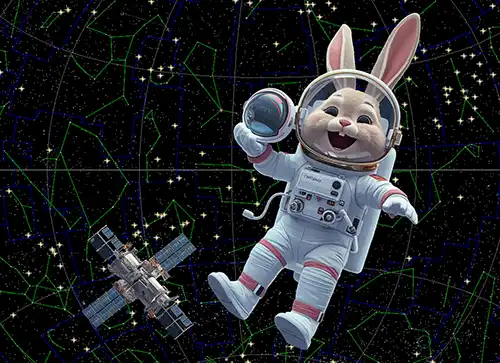 Thousands of years ago, when the first man looked curiously into the night sky, he saw an infinite number of twinkling dots.
There were so many of them that his head was spinning! But humans have always loved to organize the world.
And so began the great game of connect-the-dots.
Thousands of years ago, when the first man looked curiously into the night sky, he saw an infinite number of twinkling dots.
There were so many of them that his head was spinning! But humans have always loved to organize the world.
And so began the great game of connect-the-dots.
The ancient Greeks saw their gods among the stars: Orion, the great hunter, and Cassiopeia, the enthroned queen. The Sumerians knew the constellations of the scorpion, the Egyptians saw the silhouette of a lion, and the Chinese – a dragon coiling across the sky.
Every people drew their own pictures in the sky and told stories about them – of love, betrayal, heroism, and fear. The stars became an open book for the imagination.
Centuries passed. Sailors went to sea with star maps in their hands. They needed new navigational markers, so they added constellations unknown to the ancients: "Bird of Paradise," "Giraffe," "Toucan"... There were no gods in them – only exotic animals from distant lands, discovered during great voyages. The sky became a traveler's album full of strange creatures.
Then came the age of science. People began to look at the sky through telescopes and measure the paths of the planets. And they changed the constellations again: "Microscope," "Pump," "Spyglass" appeared... The sky was no longer just a stage for myths – it became the workshop of scientists who wanted to understand the cosmos.
Today we know that stars are enormous nuclear furnaces, scattered across space at incredible distances. Neither of them sticks to the other – it's us, from Earth, who connect them into pictures, like children drawing lines between dots in a coloring book.
But the story doesn't end there. Engineers are already building rockets that will one day take humans to other stars. And when the first human stands on the planet orbiting Proxima Centauri and looks up, they will see a completely different sky.
And that same beautiful human need will begin again: to connect twinkling dots into new shapes, to tell new stories, to name new constellations – perhaps "Spaceship," "Footprint on Mars," or "The Way Home."
Because the stars themselves are silent.
We give them a voice. And so it will be as long as humans raise their eyes to the sky – yesterday, today, and tomorrow.
And that's why the astronaut in our game now needs help navigating the tunnel leading to the starship.
Unfortunately, the passage has been damaged by meteorites. You must carefully guide it through the remaining undamaged squares, and, if necessary, jump over the holes.
It's just a game now, but who knows if something like this will happen again someday?
