Space Maze
The Stars Tell a Story
Help the astronaut write the next part.
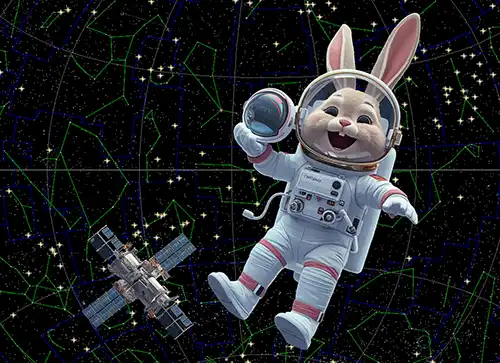 Thousands of years ago, when the first man looked curiously into the night sky, he saw an infinite number of twinkling dots. There were so many of them that his head was spinning! But humans have always loved to organize the world. And so began the great game of connect-the-dots.
The ancient Greeks saw their gods among the stars: Orion, the great hunter, and Cassiopeia, the enthroned queen. The Sumerians knew the constellations of the scorpion, the Egyptians saw the silhouette of a lion, and the Chinese – a dragon coiling across the sky.
Every people drew their own pictures in the sky and told stories about them – of love, betrayal, heroism, and fear. The stars became an open book for the imagination.
Centuries passed. Sailors went to sea with star maps in their hands. They needed new navigational markers, so they added constellations unknown to the ancients: "Bird of Paradise," "Giraffe," "Toucan"... There were no gods in them – only exotic animals from distant lands, discovered during great voyages. The sky became a traveler's album full of strange creatures.
Then came the age of science. People began to look at the sky through telescopes and measure the paths of the planets. And they changed the constellations again: "Microscope," "Pump," "Spyglass" appeared... The sky was no longer just a stage for myths – it became the workshop of scientists who wanted to understand the cosmos.
Today we know that stars are enormous nuclear furnaces, scattered across space at incredible distances. Neither of them sticks to the other – it's us, from Earth, who connect them into pictures, like children drawing lines between dots in a coloring book.
But the story doesn't end there. Engineers are already building rockets that will one day take humans to other stars. And when the first human stands on the planet orbiting Proxima Centauri and looks up, they will see a completely different sky.
And that same beautiful human need will begin again: to connect twinkling dots into new shapes, to tell new stories, to name new constellations – perhaps "Spaceship," "Footprint on Mars," or "The Way Home."
Because the stars themselves are silent.
We give them a voice. And so it will be as long as humans raise their eyes to the sky – yesterday, today, and tomorrow.
And that's why the astronaut in our game now needs help navigating the tunnel leading to the starship.
Unfortunately, the passage has been damaged by meteorites. You must carefully guide it through the remaining undamaged squares, and, if necessary, jump over the holes.
It's just a game now, but who knows if something like this will happen again someday?
Game rules
| forward: | w | or | ↑ (*) |
| backward: | s | or | ↓ (*) |
| left: | a | or | ← (*) |
| right: | d | or | → (*) |
| each square: | 2 points |
| blue: | +9 points (**) |
| yellow: | +6 points (**) |
| green: | +3 points (**) |
| flash red: | +50pkt (bonus) |
(**) - for each full field
Why is the sky full of gods, animals and machines?

Did you know this about the constellation?
Ara Ara (abbr: Ara)
Several myths surround the constellation Ara. In one tale, it symbolizes the altar where Zeus and the other gods swore an oath to vanquish the Titans and dethrone Cronus, the universe's ruler.
Cronus, one of the 12 Titans, had previously overthrown his father, Uranus.
A prophecy foretold that Cronus would suffer the same fate, being defeated by one of his own offspring. To avert this, he devoured his children — Hestia, Demeter, Hera, Hades, and Poseidon — all destined to become gods and goddesses.
Upon the birth of his youngest, Zeus, Rhea concealed him in Crete and tricked Cronus by giving him a stone wrapped as the baby to swallow.
Once grown, Zeus forced Cronus to regurgitate his siblings. Liberated, they vowed to topple Cronus and the Titans.
The ensuing war between the gods and Titans raged for ten years, ultimately ending in victory for the gods.
Zeus claimed dominion over the sky, Poseidon over the seas, and Hades over the underworld.
To honor their triumph, Zeus immortalized the altar in the stars.
Astronomical Facts
Why do we need a "fair" measurement of stars?
Thousands of years ago, Hipparchus divided stars into "first magnitude", "second magnitude", etc. The higher the value, the "fainter" the star. This was an apparent measurement - how bright the star appears from Earth.
But there's a catch: a very bright star can appear faint to us simply because it's very far away. And a weak candle right next to it looks like a strong lantern!
Imagine two lamps:
- a powerful spotlight at the other end of the stadium
- a small flashlight held directly in front of your eyes
Thus, “absolute” magnitude was born.
Astronomers began to understand this when they learned to measure the distances of stars in the 19th century. They needed a way to compare their true magnitudes, no matter how far away they were.
In 1902, Dutch astronomer Jacobus Kapteyn proposed a clever idea: “What if we placed all the stars at the same distance and then compared them?”
This conventional distance was taken to be 10 parsecs — about 32.6 light years. The magnitude a star would have at that distance was called its absolute magnitude (denoted by the letter M).
An example that explains it all. Let's take two stars:
- Sirius (the brightest in our sky): apparent magnitude = -1.46 (very bright to us!), absolute magnitude = +1.4 (in reality – a medium star)
- Deneb (in the constellation Cygnus, barely visible to the naked eye): apparent magnitude = +1.25 (looks faint), absolute magnitude = -8.4 (giant – a million times brighter than the Sun!)
Why is it important?
Absolute magnitude is like the “technical data” of a star – it tells us how powerful it really is. It allows astronomers to:
- compare different types of stars (red dwarfs, white giants, supernovae)
- understand how they evolve and how much energy they have “in reserve”
- create diagrams (brightness like the famous Hertzsprung-Russell diagram) that are like a “periodic table” of stars.
So, although we have been comparing the “brightness” of stars since the time of Hipparchus, it was Kapteyn – about a century ago – who invented this “fair” scale that we use today to plan missions to the nearest stars. Because before we set off on our journey, it's good to know what powerful "lamps" await us along the way ✨